Carbon Buildup in Direct Injection BMW & Audi Engines: Prevention Guide
"Direct injection engines build carbon on the intake valves because fuel never washes over them. By 60,000 miles, your BMW or Audi could be losing 15% of its power. Here's how to prevent it."
Engine
7/10
Gearbox
7/10
Electric
6/10
Total Risk
4/10
Quick Verdict
Buy with CautionExpect significant running costs. Manageable if preventative maintenance is done.
Reliability Verdict
Carbon buildup is a predictable maintenance item for all gasoline direct injection (GDI/FSI) engines. Fuel no longer washes the intake valves, so combustion blow-by gradually coats them in carbon deposits. The fix (walnut shell blasting) is effective, affordable, and should be part of the standard maintenance schedule around every 30,000遯カ繝サ,000 miles on affected engines.
Executive Intelligence Summary
Carbon buildup guide for direct injection cars. BMW N54/55/S63, Audi engines 遯カ霈ゥmptoms, walnut blasting cost ($400-$900), and affected engine list.
In This Guide
Carbon Buildup in Luxury Cars: Causes, Symptoms, and Fixes
Carbon buildup is one of the most misunderstood maintenance items in modern luxury performance cars. It sounds alarming. It is actually straightforward to fix 遯カ謨・long as you know which engines are affected and when to act.
1. Why Direct Injection Engines Get Carbon Buildup
In port injection engines (older technology), fuel is sprayed at the intake valve. The detergents in modern fuel perform a continuous cleaning function 遯カ閧コcess deposits are dissolved and burned away.
In gasoline direct injection (GDI/FSI) engines 遯カ豢セich include virtually every modern BMW, Audi, and Mercedes turbocharged engine 遯カ逶テl is injected directly into the cylinder, bypassing the intake valve entirely.
The intake valve is now only touched by:
- Blow-by gases from the crankcase (which contain oil mist via the PCV system).
- Recirculated exhaust gases (EGR).
Both of these deposit oily, carbon-rich residue on the intake valve head and stem. With no fuel to clean it, the residue builds up over thousands of miles.
2. Symptoms
- Cold start hesitation: Thick carbon deposits change how air flows around the valve at low temperatures. The engine hesitates, stumbles, or takes 1遯カ繝サseconds longer to settle.
- Rough low-load idle: At part throttle (traffic, crawling), the engine feels rougher than expected.
- Power plateau: At 4,000遯カ繝サ00 rpm, power feels like it stops climbing. Carbon restricts maximum airflow.
- Misfires (severe buildup): If deposits become large enough to contact the piston, they cause mechanical issues 遯カ逶フ this is rare on well-maintained cars.
3. Affected Engines
| Engine | Applications | Buildup Interval | Risk Level |
|---|---|---|---|
| BMW N54 / N55 | 335i, 535i, X5 35i | 30,000遯カ繝サ,000 mi | High |
| BMW S55 | M3 F80, M4 F82 | 30,000遯カ繝サ,000 mi | High |
| BMW S63/N63 | M5, 550i | 40,000遯カ繝サ,000 mi | High |
| Audi EA888 (1.8T/2.0T) | A4, TT, S5 | 40,000-60,000 mi | Medium |
| Audi EA839 (2.9T) | RS5, RS4, SQ5 | 30,000-50,000 mi | High |
| Audi EA824/825 (4.0T) | RS7, S8, RS6 | 30,000-50,000 mi | High |
| Lambo V10 (Pre-Evo) | Hurac・・ス。n LP610 | 25,000-30,000 mi | Medium |
Not significantly affected: Engines with port injection supplementing DI - Hurac・・ス。n EVO (2019+), BMW B-series engines (partial port injection), Mercedes M256 (partial).
Related Guides by Engine
- BMW S55 Engine Reliability Reliability & Real Costs
- BMW S63 Engine Reliability
- Audi RS5 Reliability: Pre-2019 Rocker Arm Failure & The $25,000 Engine Risk
- Audi 4.0T V8 Reliability
- Lamborghini Hurac・・ス。n Reliability: Common Problems & Repair Cost Guide ($1,500 - $5,000)
4. The Fix: Walnut Shell Blasting
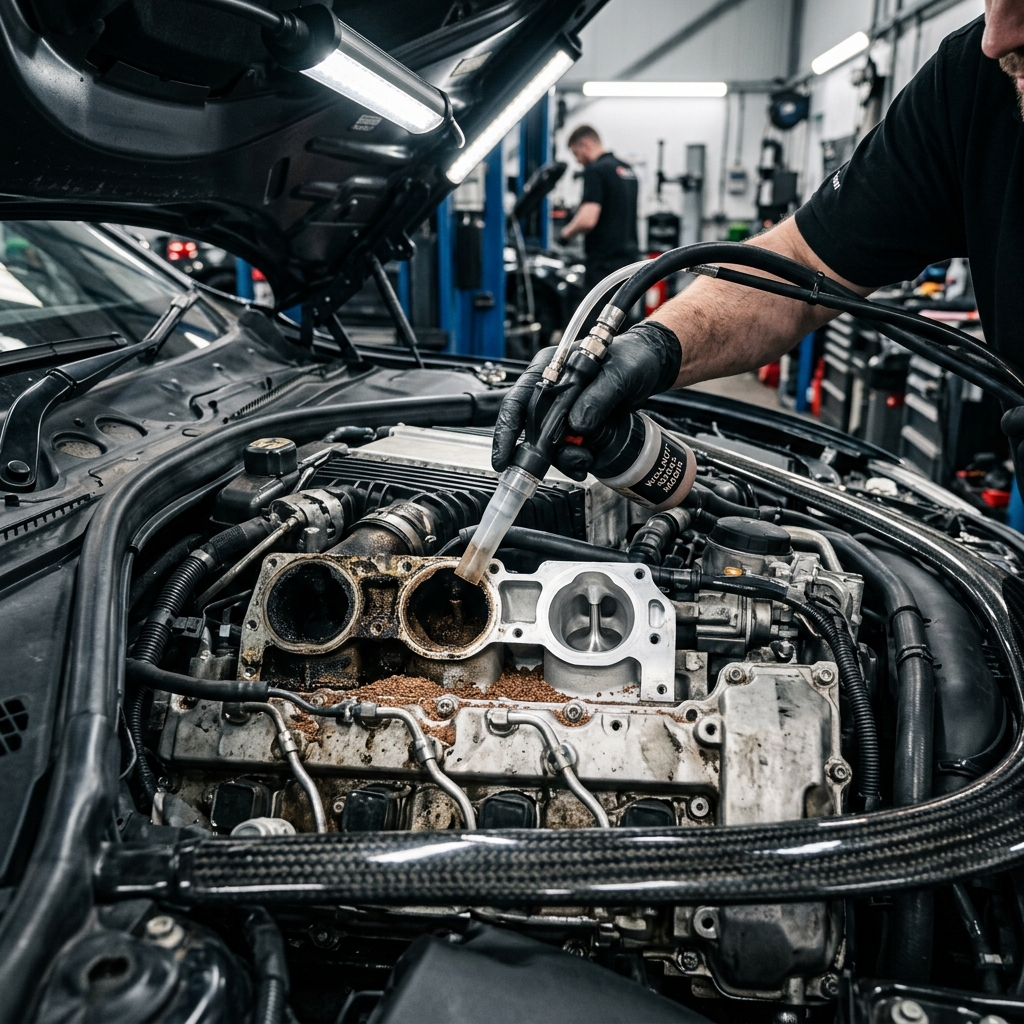
Walnut shell blasting (also called walnut media blasting or walnut blasting) is the gold-standard repair for intake valve carbon deposits.
Process:
- Intake manifold removed.
- A vacuum-and-blast gun directs walnut shell media at each valve head.
- The abrasive media breaks off carbon deposits.
- A vacuum simultaneously collects media and carbon debris.
- Intake manifold reinstalled.
Result: Valves return to near-new cleanliness. Drivability improvement is often immediately noticeable.
Cost: $400遯カ繝サ00 at an independent shop. Dealer: $800遯カ繝サ,500.
Time: 2遯カ繝サhours per bank. Simple V8: 1 day job.
5. Prevention
| Method | Effectiveness | Cost |
|---|---|---|
| Walnut blast every 30k miles | Excellent | $400遯カ繝サ00 |
| Catch can (PCV oil separator) | Good (reduces oil mist) | $150遯カ繝サ00 installed |
| Top-end cleaner additives | Minimal (cannot reach valves over DI) | $20遯カ繝サ0 |
| Short-trip avoidance | Good (keeps temps high) | $0 |
Executive Buying Advice
Ask when the intake valves were last cleaned on any BMW or Audi DI engine. If over 40,000 miles with no service: budget $400遯カ繝サ00. The fix is not urgent but improves drivability meaningfully.