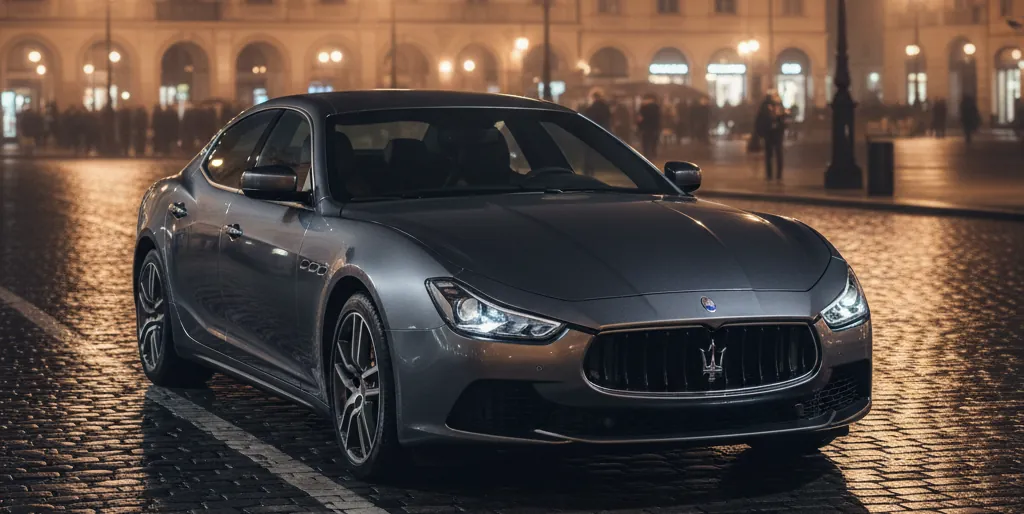
Maserati Ghibli Reliability: Common Problems, Repair Costs & Best Years to Buy
"The Ghibli is the most depreciated luxury sedan of its generation — cars that listed above $75,000 now change hands for the price of a new Camry. The discount is real, but it is not a mystery: it is the market pricing in the recalls, the electrics, and the dealer labor rates. Buy with your eyes open and the discount works for you. Buy blind and it works against you."
Engine
6/10
Gearbox
8/10
Electric
3/10
Total Risk
5/10
Quick Verdict
Buy with CautionThe engine and gearbox are not the problem — the wiring, the fuel system paperwork, and the parts prices are. A 2019+ car with every fuel recall documented and a clean electrical history is a defensible buy at today's prices. An early car bought on price alone is not.
Reliability Verdict
The Ghibli's mechanical core is better than its reputation: the Ferrari-derived F160 twin-turbo V6 is fundamentally robust and the ZF 8HP automatic is one of the most reliable gearboxes in the industry. What destroys the ownership experience is everything around that core — a decade of fuel-system recalls (six federal campaigns on one system), persistent electrical faults, and dealer-priced parts. RepairPal does not publish a reliability rating for Maserati at all, and CarEdge's data puts the Ghibli at $9,262 in maintenance over ten years with a 19.65% chance of a major repair in that period. The car is cheap to buy precisely because the market knows all of this.
Executive Intelligence Summary
Is the Maserati Ghibli reliable? Guide to the F160 V6's wastegate rattle, electrical faults, 18 NHTSA recalls, fuel-system campaigns and real maintenance costs.
In This Guide
The Ghibli has the worst reputation of any modern luxury sedan — and the strangest part is that its engine and gearbox don’t deserve it. The Ferrari-derived V6 is sound, the ZF automatic is close to unbreakable, and yet the car around them generated 18 federal recalls and an electrical fault list that keeps specialists in business. This guide separates the reputation from the record.
The Ghibli (M157) launched for 2014 as Maserati’s volume play, and it worked commercially: it put the trident on tens of thousands of driveways. It also depreciated faster than almost any rival, which is why you are reading this — the used prices are now low enough to tempt buyers who would never have considered one new.
The headline data: Start with what does not exist. RepairPal publishes no reliability rating for Maserati — the brand’s volumes are too low for its dataset, a fact worth knowing because any site quoting you a “RepairPal score” for a Ghibli invented it. The best quantified dataset is CarEdge’s: $9,262 in maintenance over ten years and a 19.65% probability of a major repair in that period — actually better than the luxury sedan average on both counts. The hard federal record is the recalls: 18 NHTSA campaigns across the 2014-2024 model years, six of them on the fuel system alone. The Ghibli’s story is not a fragile engine. It is a sound powertrain wrapped in recall-prone plumbing and temperamental electrics.
Failure Probability Timeline
The warranty phase. Factory coverage is 4 years / 50,000 miles, and most cars of this age are now well past it. Early cars accumulate recall visits — check which campaigns were actually completed.
- Fuel delivery hose recall (14V-654)
- Power seat wiring recall (17V-046)
- Rear suspension recall (16V-264)
The electrical phase. Door modules, window regulators, and sensors begin failing in sequence, and early cars develop turbo wastegate rattle.
- Door Module & Electrical Faults
- Turbo Wastegate Rattle (2014-2015 cars)
- Fuel line recall stack (18V-831)
The sorting phase. Cars with full service history and completed recalls settle into predictable, if pricey, running. Neglected cars stack electrical faults until the bills exceed the car's value.
- Accumulated Electrical Faults
- Turbo Assembly Replacement
- Deferred Service Catch-Up
*Data based on owner-reported failures and specialist shop frequency reports.
1. The Fuel System: Six Federal Campaigns on One System
No single Ghibli recall is catastrophic — the problem is the stack. The fuel system alone drew campaign after campaign across a decade, with different root causes, and a car can be inside one campaign and outside the next.
The campaigns that matter:
- 14V-654 (2014-2015, 139 cars): fuel delivery hoses improperly crimped at the factory — leak and fire risk. Remedy: full line replacement.
- 18V-831 (2014-2015, 6,334 cars): fuel lines damaged during production. This campaign supersedes 17V-045 — a car already repaired under the earlier campaign is exempt, which is exactly the kind of detail only a VIN check resolves.
- 17V-834 (2018): the fuel delivery pipe can leak at its connections.
- 21V-872 (2021, 409 cars) and its expansion 24V-269 (2021-2022): the fuel line sensor housing cracks and leaks — a different part, a different decade of production, the same consequence: stall and fire risk.
The buying rule: never accept “the recalls were done” verbally. Run the VIN at nhtsa.gov/recalls and match the campaign list against the car’s model year. Every remedy is free — an open fuel recall on a car you are about to buy is the seller’s unfinished paperwork, and it tells you how the car has been kept.
2. The F160 V6: A Sound Engine With One Expensive Noise
The Ghibli’s 3.0L twin-turbo V6 (the F160, built by Ferrari) is the strongest part of the car. Serviced on the factory schedule — every 12,500 miles or 12 months, per the owner’s manual — it does not have a pattern of internal failures, and it is paired with the ZF 8HP automatic, one of the most proven gearboxes ever fitted to a luxury car.
Its one signature fault is turbocharger wastegate rattle, concentrated on 2014-2015 cars. The wastegate actuator wears and rattles; Maserati’s service campaign answer was retaining clips, which specialists widely regard as a temporary measure. The permanent fix is expensive for a structural reason: the turbocharger has no serviceable internals, so the repair is a complete turbo/manifold/actuator assembly at roughly €3,000-€3,200 per side at European specialist prices (published figures; US dealer quotes differ, but the assembly-only logic is the same). If both sides are worn, double it.
The buying test: cold start, bonnet up, listen at each turbo. A pronounced metallic rattle that fades as the car warms is the wastegate signature. Price it into the deal or walk away.
3. The Electrics: The Real Ghibli Tax
Ask any Maserati specialist what fills their diary and it is not engines — it is the electrical system. Door modules are the emblematic failure: they fail often enough that specialists keep replacements in stock, and the failure pattern is sequential — one module goes, and another follows within months. Published specialist prices run €350-€1,000 per module including diagnosis and fitting, and owners who stay with a Ghibli for years should expect cumulative electrical bills in the thousands.
The federal record agrees with the workshops: electrical system faults are the largest complaint category in the NHTSA data for the model, and the recall list includes 17V-046 — an electrical short in the power seat wiring harness affecting 39,381 cars, with fire risk as the stated consequence. That campaign, like all the others, is a free remedy — but only if it was actually done.
The buying test: operate everything. Every window, every door lock, every seat motor, the sunroof, the mirrors. On a Ghibli, the electrical audit is the pre-purchase inspection.
4. The Rest of the Federal Record
Beyond the fuel system and the seat wiring, two campaigns deserve a buyer’s attention:
- 16V-264 (26,464 cars): a rear suspension defect — check completion on any early car.
- 18V-173 (2017): an engine software fault that can, at low speeds in stop-and-go traffic, shift the transmission into neutral or park or shut the engine off. A software remedy — free, and essential to verify on a 2017 car.
Eighteen campaigns across eleven model years sounds damning, and it is not a record to wave away. But note what the list is mostly made of: supplier and assembly defects with free remedies, not a pattern of engines expiring. The Ghibli’s recall history is a paperwork audit, not a death sentence — provided the paperwork was done.
5. What It Actually Costs to Run
There is no RepairPal figure to quote, so this guide uses the published datasets that do exist — and labels them:
| Job / Cost | Published Figure | Source Type |
|---|---|---|
| Maintenance over 10 years | $9,262 (19.65% major-repair probability) | CarEdge dataset |
| Average annual maintenance, early years | ~$1,500/yr | MIE Corp. (Maserati Club International) data |
| Turbo/manifold assembly (per side) | €3,000 - €3,200 | European specialist published prices |
| Door module (each, fitted) | €350 - €1,000 | Specialist published prices |
| All recall work | Free | NHTSA campaigns |
A realistic out-of-warranty budget is $2,000 - $3,500 per year with a specialist, more at dealer labor rates — against which the purchase price is now so low that the total cost of a well-bought Ghibli still undercuts a comparable German car bought newer. That arithmetic only works if the recalls are closed and the turbos are quiet.
6. Best Years to Buy (and Which to Avoid)
Buy: 2019-2024 (facelift cars). The facelift brought updated infotainment and interiors, the fuel-line production issues of the early cars were behind the factory, and these cars sit outside the densest recall years. The Trofeo’s V8 is a different price universe; the V6 S is the sweet spot.
Buy with proof: 2016-2018, if the VIN check shows the full campaign list completed and the electrical audit is clean.
Avoid: 2014-2015 cars with open recalls, any car with audible wastegate rattle priced as if it were silent, and any car whose seller describes the electrical system as “having character.” At this age, character is a quote you haven’t received yet.
For the problems in day-to-day detail, see our Maserati Ghibli common issues guide, and for the ownership experience beyond the bills, our Ghibli review.
7. Frequently Asked Questions (FAQ)
Q: Is the Maserati Ghibli reliable? A: The powertrain is; the car around it is mixed. The F160 V6 and ZF 8HP gearbox have sound records, but the Ghibli accumulated 18 NHTSA recalls (six on the fuel system alone) and its electrical system is the most failure-prone part of the car. CarEdge puts ten-year maintenance at $9,262 with a 19.65% major-repair probability — better than the class average — but RepairPal publishes no Maserati rating at all.
Q: What is the most common Maserati Ghibli problem? A: Electrical faults — door modules above all, which fail often enough that specialists stock them and tend to fail in sequence. The most serious documented issues are the fuel-system recalls, all of which carry free remedies.
Q: How much does it cost to maintain a Ghibli per year? A: Budget $2,000 - $3,500 per year out of warranty at a specialist. CarEdge’s ten-year maintenance total is $9,262, but that is a young-car average; an older car needing a turbo assembly (€3,000-€3,200 per side at European specialist prices) will exceed it in a single visit.
Q: Which Ghibli years should I avoid? A: 2014-2015 cars carry the densest recall stack (14V-654, 18V-831, 17V-046, 16V-264) and the wastegate rattle risk. They are buyable only with completed-recall paperwork and a quiet cold start. The 2019+ facelift cars are the safest buys.
Q: Is a high-mileage Ghibli worth buying? A: Only with a full service file and a clean electrical audit. A documented 90,000-mile car is a better purchase than a 50,000-mile car with open recalls and a seller who can’t produce a single invoice.
8. Related Resources
- Maserati Ghibli Common Issues
- Maserati Ghibli Review
- Maserati Levante Reliability
- Maserati Ghibli 2025 Practical Guide
- Maserati Quattroporte Review
- Maserati GranTurismo Review
- Alfa Romeo Giulia Quadrifoglio Reliability
- Most Dangerous Used Luxury Cars
Real Owner Symptoms
"My 2015 Ghibli S rattled from the right turbo on every cold start. The specialist knew the sound before I finished describing it — wastegate wear, and the fix is a complete turbo and manifold assembly because nothing inside is serviceable. Then a door module failed, and a second one followed six months later, exactly as the forum said it would."
Mechanic's Diagnosis Notes
We keep Ghibli door modules on the shelf because we know we will need them. The pattern on these cars is consistent: the F160 engine itself rarely gives us trouble if it has been serviced on the 12,500-mile schedule, the ZF gearbox almost never does, and the electrical system gives us a steady stream of work. Check the fuel recall history on every single car — six campaigns on one system means a car can have had one done and still be inside another.
Cost Transparency: Parts + Labor Breakdown
| Repair Job | Est. Parts | Est. Labor | Total Worst-Case |
|---|---|---|---|
| Turbocharger / Manifold Assembly (per side, wastegate wear) | €2,400 | €700 | €3,000 - €3,200 (European specialist published prices) |
| Door Module Replacement (each) | €250 - €700 | €100 - €300 | €350 - €1,000 (specialist published prices) |
| Fuel System Recall Work (all campaigns) | Covered | Covered | Free (NHTSA Recall) |
| Annual Scheduled Service (dealer) | Varies | Varies | Budget ~$1,500/yr average over the first years (MIE Corp. data) |
Executive Buying Advice
Run the VIN through NHTSA before anything else and count the fuel-system campaigns: 14V-654 and 18V-831 (2014-2015 cars), 17V-834 (2018), 21V-872 and its expansion 24V-269 (2021-2022). Then listen to both turbochargers on a cold start for wastegate rattle, and test every door module, window, and seat function — electrical faults arrive in sequence, so one dead module usually means another is coming. Buy the car with the thickest service file, not the lowest sticker.
What Owners Regret
"I bought the cheapest 2014 in the state because it was $6,000 under everything else. It needed the fuel line recall sorting, a turbo for the rattle, and two electrical modules in the first year. The 'saving' lasted about four months."
Lower-Risk Alternatives
- BMW 5 Series (G30) The rational alternative. The B58-powered 540i is quicker than a base Ghibli, cheaper to run, and supported everywhere — it just doesn't sound like a Maserati.
- Maserati Quattroporte (GTS) If the badge is the point, the Quattroporte GTS adds the Ferrari-derived 3.8 V8. It shares the electrical temperament but adds genuine supercar pace — see our Quattroporte review.
- Porsche Panamera (971) The driver's choice in this class with a far deeper reliability record. See our Panamera Turbo 971 problems guide for its own, much shorter, list of issues.