Alfa Romeo Giulia Quadrifoglio Reliability: Common Problems, Repair Costs & Ownership Guide
"Every Quadrifoglio owner has given the same speech: the engine is a Ferrari V8 with two cylinders removed, the steering is the best in the class, and no, it has not broken down. The speech is mostly true. What the speech leaves out is the service schedule — because on this car the schedule itself, followed properly, costs what a breakdown costs on other cars."
Engine
7/10
Gearbox
8/10
Electric
5/10
Total Risk
6/10
Quick Verdict
Buy with CautionThe engine is not the gamble it is reputed to be; the consumables are the gamble. A Quadrifoglio with a documented belt service, completed recalls, and steel brakes (or priced-in ceramics) is a rational purchase at today's prices. One with a missing belt receipt is a $3,000 negotiation before you have driven a mile.
Reliability Verdict
The Quadrifoglio's reputation problem is partly real and partly an evidence problem. There is no Quadrifoglio-specific reliability dataset: RepairPal's Giulia figures (3.0 out of 5.0, roughly $840 a year) describe a model line dominated by 2.0-litre cars, and J.D. Power scored the 2024 Giulia 81 out of 100 for quality and reliability — again, the line, not the 505 hp flagship. What is specific to the Quadrifoglio is documented and priceable: a Ferrari-derived 2.9L V6 whose accessory belt is a scheduled replacement at a maximum of 36,000 miles or four years (owner's manual), costing $2,000-$3,000 at a dealer; optional carbon-ceramic brakes whose replacement is a five-figure event; and a share of the Giulia line's 17 NHTSA campaigns, including the 53,849-car fuel-pump recall (25V-586) and the carbon-ceramic rotor recall (23V-382). The ZF 8-speed is the same proven gearbox BMW uses. Buy the car with the belt receipt and the recall file closed, and the Quadrifoglio is an expensive hobby. Buy it without them, and the first service visit will explain the reputation.
Executive Intelligence Summary
Is the Giulia Quadrifoglio reliable? The 505 hp Ferrari-derived V6, 36,000-mile belt service, carbon-ceramic brake costs, NHTSA recalls and real ownership costs.
In This Guide
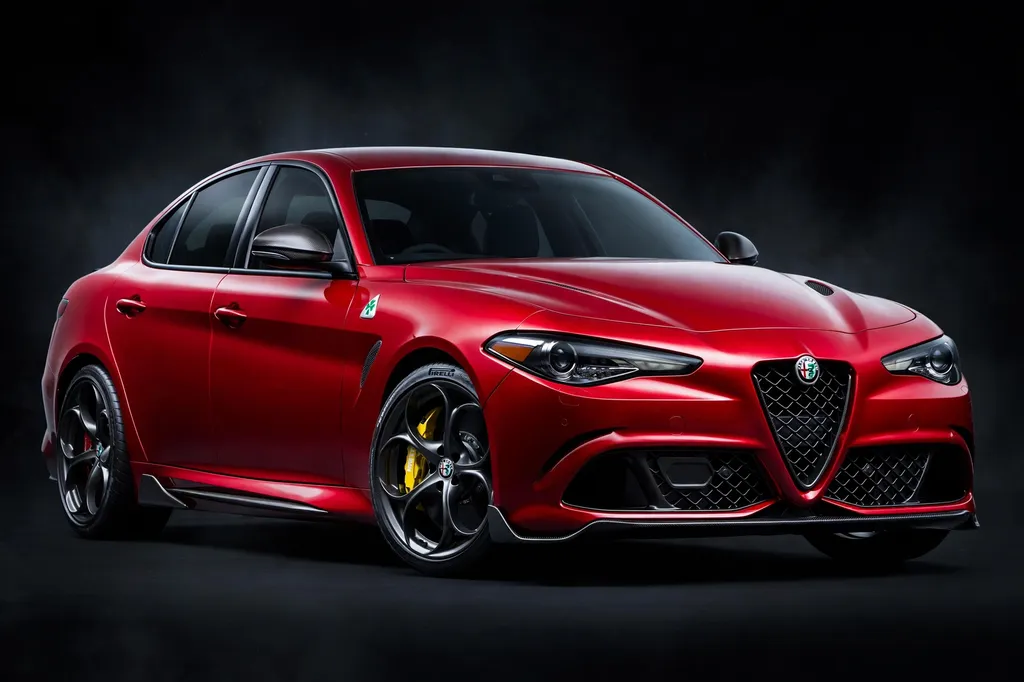
The Giulia Quadrifoglio is the car that relaunched Alfa Romeo in America: a 505 hp twin-turbo V6 derived from Ferrari’s F154 V8 programme, the fastest four-door around the Nürburgring on its debut, and — in the retelling — a reliability disaster. The documented record is more interesting than the reputation. This guide separates what is actually known about the Quadrifoglio from what is merely said about it, and prices the items that are genuinely its own: the belt service, the carbon brakes, and the tires.
The Quadrifoglio (2017-2024 in the US) sits on the Giorgio platform with rear-wheel drive and the ZF 8HP75 automatic — the same gearbox family BMW fits across its range. Its engine, the 2.9L “690T” V6, is a 90-degree twin-turbo unit developed under Ferrari influence with cylinder deactivation, rated at 505 hp. Carbon-ceramic brakes were a cost option; steel brakes were standard. Alfa Romeo’s factory warranty was 4 years / 50,000 miles.
The headline data — and its limit: there is no Quadrifoglio-specific dataset from any major source. RepairPal rates the Giulia line at 3.0 out of 5.0 with an average annual repair cost of roughly $840, against an Alfa Romeo brand average of $834 — figures built mostly from 2.0-litre cars. J.D. Power scored the 2024 Giulia 81 out of 100 for quality and reliability. Both describe the family, not the flagship. What is Quadrifoglio-specific is in the owner’s manual, the recall record, and the parts catalogue — and that is where this guide concentrates.
Failure Probability Timeline
The warranty and first-belt phase. The accessory belt reaches its manual limit at 36,000 miles or four years — on low-mileage cars, the calendar limit arrives first. Early cars (2017-2019) carry the fuel-pump recall.
- Accessory Belt Due (36k mi / 4 yr)
- Fuel Pump (Recall 25V-586, 2017-2019)
- Software & Battery Faults
The consumables phase. A second belt interval approaches, Corsa tires cycle every 8,000-12,000 miles, and carbon-ceramic rotor condition becomes the car's largest single financial variable.
- Second Belt Interval
- CCM Rotor Wear (if equipped)
- P Zero Corsa Replacement
The specialist phase. High-mileage Quadrifoglios are maintained by marque specialists, not dealers. The engine's fundamentals are sound; the costs are access labour, brakes, and the electrical ecosystem of an ageing low-volume Italian car.
- Belt Service (third interval)
- Alternator & Charging System
- Electrical / Module Faults
*Data based on owner-reported failures and specialist shop frequency reports.
1. The Honest Data Problem
Alfa Romeo sold the Giulia in small numbers, and the Quadrifoglio was a fraction of those. The consequence for a buyer is that every headline reliability figure for this car describes the 2.0-litre Giulia, because that is what the fleets, claims systems, and survey panels contain. RepairPal’s 3.0/5.0 and ~$840 a year, and J.D. Power’s 81/100, are the best line-level evidence available — useful for the platform’s electrical architecture and dealer network, silent on the 2.9L engine’s behaviour at 80,000 miles.
The Quadrifoglio-specific evidence base is different in kind: NHTSA’s campaign record (the Giulia line accumulated 17 campaigns across 2017-2025, and 285 complaints of which fuel and propulsion systems were the most-reported category at 98), the owner’s manual service schedule, and published specialist pricing. This guide is built from those three, and labels each figure with its source as it goes. Where a number is a model-line figure standing in for a Quadrifoglio figure, it says so.
2. The Belt Service: The Quadrifoglio’s Signature Bill
The 2.9L V6’s accessory drive belt is a scheduled service item with an unusually hard limit. The owner’s manual specifies replacement at a maximum of 36,000 miles, and every four years regardless of mileage — a shorter interval than most owners expect, driven by the access the job requires: the belt service on this engine is labour-heavy front-of-engine work, not a Saturday-morning belt swap.
Published estimates put the job at $2,000-$3,000 at a dealer and $1,200-$1,500 at an independent specialist. It is not a repair and it is not a defect — it is the price of the engine’s packaging, arriving on a four-year metronome for the life of the car. A 2018 car should be on its second belt by now; a 2021 car is due on time alone. The belt receipt is the single most valuable document in a used Quadrifoglio’s history file, and its absence is a four-figure deduction, not a detail.
3. Carbon-Ceramic Brakes and Corsa Tires
The optional carbon-ceramic brake package is the Quadrifoglio’s largest single cost variable, and it comes with its own recall: 23V-382 covers 2017-2020 Giulia and Stelvio models with carbon-ceramic brakes, in which excessive brake clamp force can damage the rotors — the remedy is a free software and hardware update, and completion should be verified by VIN on any CCM car.
Replacement economics are severe. Published estimates for a full carbon-ceramic rotor set vary widely by market — European published figures run €6,000-€9,000, while US owner reports for a full dealer set reach roughly $25,000 — but every source agrees on the order of magnitude: five figures. Rotors are assessed by weight, not appearance, so a pre-purchase inspection on a CCM car must include weighing them. The rational alternatives are a steel-brake car (standard equipment, conventional costs) or a CCM car priced with its rotor life measured and deducted. Steel conversion rotors exist in the aftermarket at a fraction of ceramic prices.
The tires are the quieter metronome. The standard-fit Pirelli P Zero Corsa is a track-biased tire: published figures put a set at $2,200-$2,600 with a realistic life of 8,000-12,000 miles. A Quadrifoglio driven as intended consumes a set roughly annually — budget for it as fuel, not as failure.
4. The Recall File: 17 Campaigns
The Giulia line’s 17 NHTSA campaigns are mostly shared with the 2.0L cars, and the Quadrifoglio buyer should verify completion of the ones that reach the flagship:
- 25V-586 (2025): fuel pump failure causing loss of drive, 2017-2019 Giulia and Stelvio, 53,849 vehicles — the line’s largest campaign, and Quadrifoglios are explicitly in the population. Remedy: replacement fuel delivery module, free.
- 23V-382 (2023): carbon-ceramic brake rotor fracture risk, 2017-2020 (see Section 3).
- 17V-823 (2017): contaminated brake fluid on 2018 cars, which could degrade braking performance.
- 24V-943 (2024): brake pedal fastener separation risk, 2019-2020, 2,021 vehicles.
- 24V-510 (2024): seat-belt buckle switch and airbag connector faults, 2017-2024, part of a 337,128-vehicle FCA-wide campaign.
- 19V-551 (2019): body control module software causing an inaccurate fuel gauge, 2018-2019, 21,914 vehicles.
- 25V-667 (2025): backup camera display failure, 2020-2025, 62,910 vehicles across Giulia and Stelvio.
All recall remedies are free at franchised dealers regardless of age, and an open campaign on a used car is an afternoon’s errand — but an undocumented one is evidence about the previous owner’s diligence, which on this car is information worth having. The complaint data reinforces the pattern: of 285 NHTSA complaints for the Giulia, fuel and propulsion systems lead at 98 — the fuel-pump campaign is the line’s real story, and it is a solved one.
5. What It Actually Costs to Run
| Job / Cost | Published Figure | Source Type |
|---|---|---|
| Average annual repair cost (Giulia line) | ~$840 | RepairPal dataset (2.0L-dominated) |
| Accessory belt service | $2,000 - $3,000 dealer / $1,200 - $1,500 specialist | Published estimates |
| Carbon-ceramic rotors (full set) | Five figures (US owner reports ~$25,000) | Owner reports / published estimates |
| Pirelli P Zero Corsa tires (set) | $2,200 - $2,600 per 8,000 - 12,000 miles | Published estimates |
| Water pump (Giulia line) | $656 - $810 | RepairPal Estimator (2020) |
| Alternator (Giulia line) | $933 - $1,514 | RepairPal Estimator (by year) |
| Oil pan gasket (Giulia line) | $1,971 - $2,821 | RepairPal Estimator |
| Fuel pump recall (25V-586) | Free | NHTSA campaign |
Budget $2,000-$3,500 a year for a Quadrifoglio out of warranty — the belt amortised, a tire set roughly annually, and line-level repairs at RepairPal Estimator prices — plus a separate, verified answer on the carbon brakes before purchase. That is M-car money, not exotic-car money. The Quadrifoglio’s costs are spiky rather than constant, and every spike is visible in advance: belt date, rotor weight, tire tread. Few performance cars let you read their next three years of bills off a checklist.
6. Best Years to Buy
Buy: 2020-2024. The facelifted cars bring updated infotainment and interior trim, sit outside the 2017-2019 fuel-pump campaign population (the remedy is free in any case), and — critically — are new enough that a complete belt and recall history is obtainable. The 2024 cars are the last of the line.
Buy with documents: 2017-2019. The cheapest Quadrifoglios and the purest spec, but the checklist is non-negotiable: 25V-586 completed, belt current by both clocks, CCM rotors weighed if fitted.
Avoid: any car — any year — with an overdue belt sold at a current-belt price, and any carbon-ceramic car whose rotors have never been weighed. On this model, the service file is not supporting evidence. It is the car.
The rivals frame the choice: the BMW M4 (F82) and M3 (F80) offer evidence where the Alfa offers feel; the engine’s Ferrari kinship is covered in our F154 engine reliability guide; and the other Italian answer at this money is the Maserati Ghibli.
7. Frequently Asked Questions (FAQ)
Q: Is the Alfa Romeo Giulia Quadrifoglio reliable? A: The honest answer is that no Quadrifoglio-specific dataset exists. The Giulia line rates 3.0 out of 5.0 on RepairPal (~$840 a year) and 81 out of 100 with J.D. Power for 2024 — figures dominated by 2.0L cars. The Quadrifoglio-specific record is a strong engine with an expensive service schedule: a belt service every 36,000 miles or four years, five-figure carbon brakes, and a 17-campaign recall file that is mostly shared with the line and free to complete.
Q: What is the Quadrifoglio’s most expensive maintenance item? A: The accessory belt service is the recurring one — $2,000-$3,000 at a dealer, $1,200-$1,500 at a specialist, due at 36,000 miles or four years per the owner’s manual. The largest single item is a full carbon-ceramic brake set on CCM cars: five figures, with US owner reports around $25,000.
Q: How much does it cost to maintain a Giulia Quadrifoglio per year? A: Budget $2,000-$3,500 a year out of warranty: the belt service amortised over its four-year interval, a set of P Zero Corsas ($2,200-$2,600) every 8,000-12,000 miles, and ordinary repairs at RepairPal Estimator prices for the Giulia line.
Q: Does the Quadrifoglio have timing belt problems? A: The 2.9L V6 uses a timing chain; the scheduled item is the accessory (serpentine) belt, which the owner’s manual limits to 36,000 miles or four years. Its cost is an access-labour story, not a failure story — but an overdue belt is the first thing to check on any used car.
Q: Which Quadrifoglio years are best? A: 2020-2024 for the updated cabin and the cleanest recall position; 2017-2019 are fine buys with the fuel-pump recall (25V-586) completed and a current belt. Every year, the documents matter more than the model year.
8. Related Resources
- BMW M4 (F82) Reliability
- BMW M3 (F80) Reliability
- Ferrari F154 Engine Reliability
- Maserati Ghibli Reliability
- Mercedes-AMG C63 (W205) Reliability
Real Owner Symptoms
"Mine is a 2019 with 41,000 miles. The belt service came due on time, not miles, and the dealer quote was $2,700. My specialist did it for $1,450 and showed me the old belt — it looked fine, which is exactly what a belt looks like before it doesn't. The car has needed nothing else beyond tires. It eats tires."
Mechanic's Diagnosis Notes
The 2.9 is a strong engine — it is the F154 architecture with a bank missing, and it does not share the Giulia 2.0's fault list. What I check on a Quadrifoglio: belt date first, because the job is priced by access, not parts. Then the brakes — carbon rotors need weighing, not eyeballing. Then software: half the 'electrical problems' on these cars are a tired battery and out-of-date modules. The ZF gearbox is the least of your worries; it is the same unit I see in half the BMWs on the lift.
Cost Transparency: Parts + Labor Breakdown
| Repair Job | Est. Parts | Est. Labor | Total Worst-Case |
|---|---|---|---|
| Accessory Belt Service | Varies | Varies | $2,000 - $3,000 dealer / $1,200 - $1,500 specialist (published estimates) |
| Carbon-Ceramic Brake Rotors (full set) | Varies | Varies | Five figures (published estimates vary by market; owner reports ~$25,000 US) |
| Pirelli P Zero Corsa Tires (set of four) | Varies | Varies | $2,200 - $2,600 (published estimate) |
| Fuel Pump Recall (25V-586) | Covered | Covered | Free (NHTSA Recall) |
Executive Buying Advice
Three documents decide the car. First, the accessory belt receipt: the manual's limit is 36,000 miles or four years, and a car past either without proof is a car you are buying mid-service — deduct $2,000-$3,000 (dealer price) or walk. Second, the recall file: 25V-586 (fuel pump, 2017-2019) and, on carbon-ceramic cars, 23V-382 must show as completed against the VIN. Third, the brake invoice history: on a CCM car, establish rotor condition and remaining life before discussing price, because a full set is a five-figure event.
What Owners Regret
"I bought the cheapest Quadrifoglio in the country and skipped the pre-purchase inspection because the car 'felt tight.' The belt was two years overdue, the carbon rotors were at minimum weight, and the fuel-pump recall was open. The car was not cheap. The inspection would have been."
Lower-Risk Alternatives
- BMW M3 (F80) / M4 (F82) The rational rival: a larger dataset, a bigger specialist network, and its own documented S55 issues — see our M3 and M4 reliability guides. Less steering feel, more evidence.
- Mercedes-AMG C63 (W205) The V8 alternative with a stronger reliability dataset and a twin-turbo 4.0L — see our C63 reliability guide. Heavier, less delicate, less special.
- Maserati Ghibli The Italian alternative at half the price: shares the Quadrifoglio's thin-dataset problem and adds its own — see our Ghibli reliability guide. A different, softer kind of car.