Maintenance vs Repair: Understanding the True Cost of Luxury Car Ownership
"Spending ,200 on a preventative rod bearing service saves you from a ,000 engine rebuild. Understanding the line between maintenance and repair is the key to affordable luxury car ownership."
Engine
4/10
Gearbox
4/10
Electric
3/10
Total Risk
7/10
Quick Verdict
AvoidExtremely high risk of catastrophic failure. Requires massive emergency budget.
Reliability Verdict
The depreciation curve of a $140,000 luxury car drops it to $40,000 in 5 years. However, the maintenance on that car is still priced for a $140,000 vehicle. Buyers who stretch to buy the $40,000 car cannot afford the $3,000 annual maintenance, leading directly to $15,000 catastrophic failures.
Failure Probability Timeline
First owner phase. Deals strictly with baseline maintenance. Cars rarely fail here.
Second owner phase. The 'Maintenance Cliff' occurs. Spark plugs, DCT fluids, brake rotors all come due simultaneously.
Third owner phase. If previous owners deferred maintenance, the car crosses the threshold into catastrophic repair territory.
*Data based on owner-reported failures and specialist shop frequency reports.
Executive Intelligence Summary
Why 'cheap' luxury cars financially ruin their second owners. Discover the critical difference between $500 maintenance and $10k catastrophic repairs.
In This Guide
The 25% Rule: Maintenance vs. Repair in High-End Luxury Cars
Warning
The Depreciation Trap: A $140,000 Maserati Quattroporte drops to $35,000 on the used market within 6 years. But the brakes, the engine out-services, and the twin-turbos still charge $140,000-level retail parts and labor rates. If you buy the car because you can just barely afford the $35,000 loan, the car will financially ruin you.
There is a fundamental misunderstanding in the used car market between Maintenance and Repair.
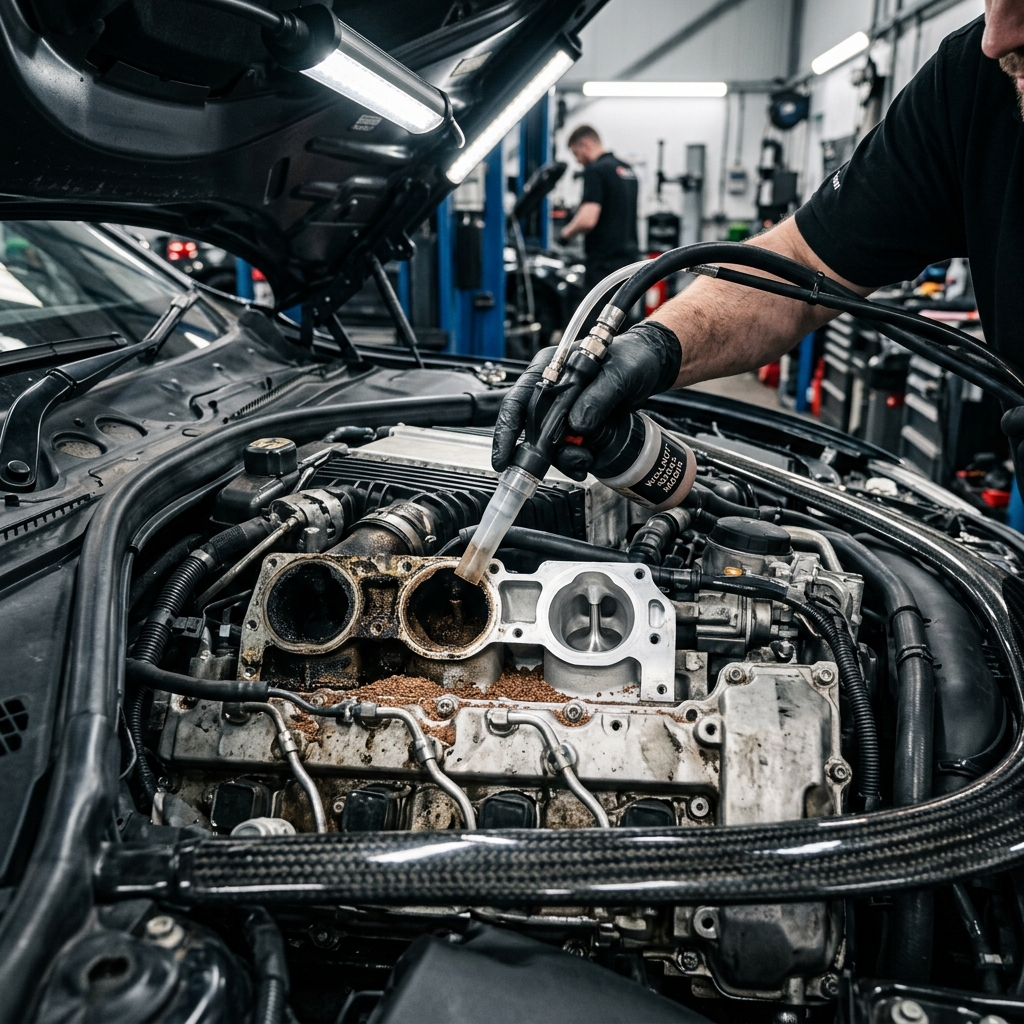
In a Honda Civic, skipping an oil change or delaying a belt replacement usually just means the car runs a little rougher. In a highly-strung European luxury car, skipping a $500 maintenance interval almost always guarantees a $10,000 catastrophic repair.
1. Defining the Terms
What is “Baseline Maintenance?”
Maintenance is the predictable, scheduled replacement of wear items required to keep the machine operating within factory tolerances.
- Examples: Synthetic oil changes every 5,000 miles, replacing spark plugs at 40k, flushing PDK/ZF transmission fluid at 60k, replacing the engine air filters.
- The Cost: In the luxury world, baseline maintenance runs between $1,500 and $3,000 per year.
What is a “Catastrophic Repair?”
A repair is the sudden, unpredictable failure of a major mechanical or electrical component, often caused by neglecting baseline maintenance.
- Examples: A spun BMW M5 Reliability & Real Costs (BMW S63) due to 15,000-mile oil changes, an overheated and warped engine block because a weeping water pump was ignored, a burned-out air compressor because a leaky air bladder wasn’t replaced.
- The Cost: In the luxury world, catastrophic repairs start at $4,000 and easily exceed $20,000.
2. The Maintenance Cliff
Luxury cars are engineered brilliantly, but they are engineered tightly. When a component is rated to last 60,000 miles, it often fails at 65,000 miles.
Most luxury cars are leased for 3 years / 36,000 miles. The first owner enjoys trouble-free motoring.
The second owner buys the car at 40,000 miles. At 60,000 miles, they hit the Maintenance Cliff. Suddenly, the car demands:
- Carbon Ceramic or high-performance steel brake replacement ($2,500)
- Dual-Clutch Transmission fluid service ($1,200)
- Spark plugs and coil packs ($1,000)
- Coolant and differential flushes ($500)
- A set of high-performance Michelin Pilot Sport 4S tires ($1,800)
The second owner is suddenly faced with a $7,000 service bill.
3. The Path to Ruin: Deferred Maintenance
When faced with a $7,000 bill, the stretched 2nd or 3rd owner decides to cut corners.
- “The brakes still stop the car, I’ll wait.”
- “Transmission fluid is ‘lifetime fill’, right? I’ll skip it.”
This is the exact moment a reliable luxury car transforms into a money pit.
By skipping the $1,200 transmission service, the internal solenoids clog with microscopic metal shavings. 20,000 miles later, the transmission loses reverse gear, requiring a $12,000 complete replacement.
By ignoring a small coolant leak because fixing the plastic crossover pipe costs $1,500, the pipe eventually bursts under highway load. The aluminum V8 engine instantly overheats, warps the cylinder heads, and necessitates a $22,000 engine swap.
4. The 25% “Slush Fund” Rule
If you are buying a European luxury car outside of its factory warranty period, you must apply the 25% Rule.
You must have 25% of the vehicle’s USED purchase price sitting in liquid cash on the day you buy it.
The Math in Action: You buy a used 2016 BMW M5 for $40,000. You must have $10,000 in your checking account untouched.
Why? Because immediately after purchasing, the car will require:
- A rigorous baseline service to fix the previous owner’s deferred maintenance ($3,000)
- Preventative replacement of known failure points, like S63 BMW M5 Reliability & Real Costs ($3,500)
- A reserve for the first random control module or sensor failure ($2,000)
If you cannot afford the car plus the 25% Slush Fund, you cannot afford the car.
5. Summary Verdict: Respect the Engineering
German and Italian engineering is not inherently “unreliable.” It is, however, completely unforgiving of poverty.
If you treat a Porsche 911 or a Range Rover like a Toyota Corolla - aiting for things to break before you spend money on them - he car will financially execute you.
- Be proactive, not reactive.
- Assume the previous owner lied about their service history unless they produce physical receipts.
- Foundational, expensive maintenance is the only shield between you and a catastrophic repair bill.
Recommended Intelligence
- Is a Luxury Car Extended Warranty Worth It?
- Most Expensive Car Repairs Global Hub
- BMW M5 S63 Preventative Rod Bearing Cost
Executive Buying Advice
Never buy a depreciated luxury V8/V12 without immediately reserving 25% of the purchase price in cash. If the car costs $40,000, you must have $10,000 in the bank on day one to cover the inevitable deferred maintenance.