Engine Knocking in Luxury Cars: When to Worry & What It Costs
"Rod knock, piston slap, and carbon detonation all sound similar to the untrained ear. But each has a different repair cost: , ,000, or ,000. Here's how to tell them apart."
Engine
2/10
Gearbox
2/10
Electric
1/10
Total Risk
9/10
Quick Verdict
RunExtremely high risk of catastrophic failure. Requires massive emergency budget.
Reliability Verdict
A rhythmic knocking noise from the lower block is the most severe symptom a luxury engine can exhibit. If you hear this, TURN OFF THE ENGINE IMMEDIATELY. Continued driving guarantees a $25,000+ engine replacement.
Executive Intelligence Summary
Diagnose an engine knocking or ticking sound on cold start in a luxury car. From BMW S65/S85 rod bearings to Porsche bore scoring, learn the symptoms and risks.
In This Guide
An engine knocking noise is the sound every luxury car owner dreads. When you’re driving a high-performance vehicle with a tightly wound, high-compression engine, a metallic knocking is rarely a cheap fix.
This guide breaks down the difference between a harmless injector tick and catastrophic BMW M5 Reliability & Real Costs failure, focusing on the engines where this is a known, multi-thousand dollar issue.
What Does Engine Knock Actually Sound Like?
Not all engine noises are catastrophic. Luxury engines, particularly modern Direct Injection (DI) turbos, are naturally noisy.
- The “Good” Tick (Direct Injectors): A rapid, light ticking sound coming from the top of the engine underneath the plastic cover. It sounds almost like a sewing machine. This is normal high-pressure fuel injector operation.
- The Warning Tick (Lifters / Cam Adjusters): A louder clatter from the top of the cylinder heads that happens immediately on a cold start but fades away after 30-60 seconds as oil pressure builds. Known on the Mercedes M156 V8.
- The Death Knock (Rod Bearings): A deep, rhythmic, heavy, metallic knocking sound coming from the bottom of the engine block. It speeds up precisely as you rev the engine. If you lift off the throttle and hear a distinct rattle, the bearing clearance is gone.
The Biggest Offenders: Engines Prone to Knocking
1. BMW S65 (E92 M3) and S85 (E60 M5)
These legendary naturally aspirated engines spin to 8,250+ RPM. However, the factory rod bearing clearances were excessively tight for the thick 10W-60 oil specified by BMW. As miles accumulate, the bearings starve for oil on cold starts, wipe the protective layer, and eventually spin around the crankshaft.
- The Fix: Preventative replacement every 60,000 to 80,000 miles is mandatory. Upgraded WPC-treated bearings with ARP bolts expand the clearance.
- Read the Deep-Dive: Used BMW M5 F10 Buying Guide Reliability & Real Costs
2. Porsche 997.1 911 (M96/M97 Engines) - Bore Scoring
While not a traditional rod knock, Porsche 997s (especially the 3.8L Carrera S in cold climates) suffer from cylinder bore scoring. The piston coating degrades, scratching the cylinder wall.
- The Symptom: It produces a “piston slap” knocking sound from the rear of the car, accompanied by one blackened exhaust tip and high oil consumption.
- The Fix: A complete engine rebuild with Nickies-sleeved cylinders ($20,000+).
- Read the Deep-Dive: Porsche 9A1 / 9A2 Engine Reliability Reliability & Real Costs
3. Mercedes-AMG M156 6.2L V8 - Cam Lobe Wear
Often confused with a rod knock, the legendary 6.2L AMG V8 suffers from soft camshaft lobes and weak hydraulic lifters.
- The Symptom: A loud, highly aggressive ticking from the top of the engine that doesn’t go away when warm.
- The Fix: Replacement of all 32 lifters (tappets) and all four camshafts with SLS-black series hardened variants.
How to Protect Yourself Before Buying
If you are inspecting a used high-performance luxury car:
- Cold Start Only: Never let the seller warm the car up before you arrive. Rod knock and lifter tick are incredibly obvious when the oil is cold and thick.
- Blackstone Oil Analysis: This is non-negotiable for an M car or a high-mileage Porsche. A $35 lab test will detect microscopic copper or lead particles in the oil long before you can hear a knock.
- Check the Filter: If you own the car, the easiest way to check for impending doom is to pull the oil filter, cut the paper pleats open, and shine a flashlight. If it looks like a disco ball (glitter), your engine needs to be shut off and towed to a specialist immediately.
Real Owner Symptoms
"Owners describe a metallic 'tap-tap-tap' that increases with engine RPM, most noticeable during a cold start or when lifting off the throttle. It often sounds like a diesel engine or marbles rattling in a can."
Mechanic's Diagnosis Notes
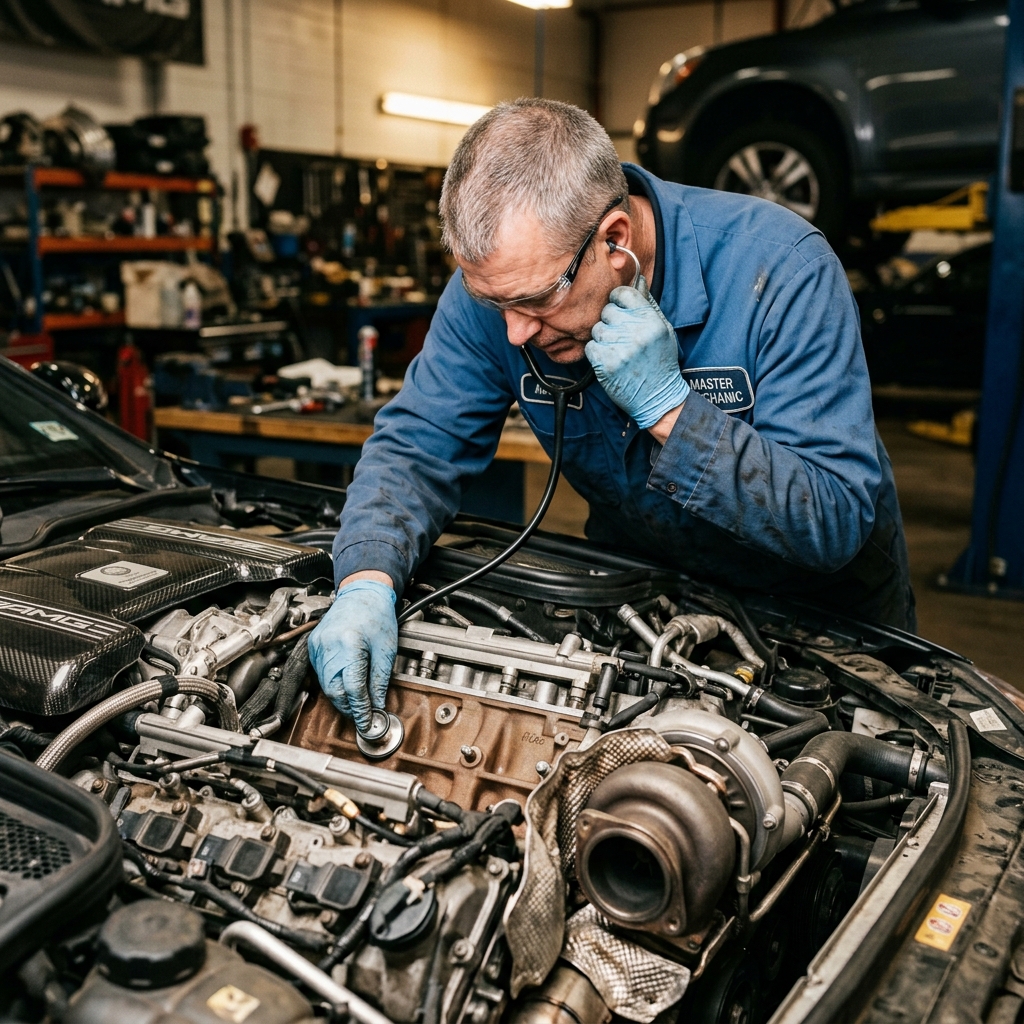
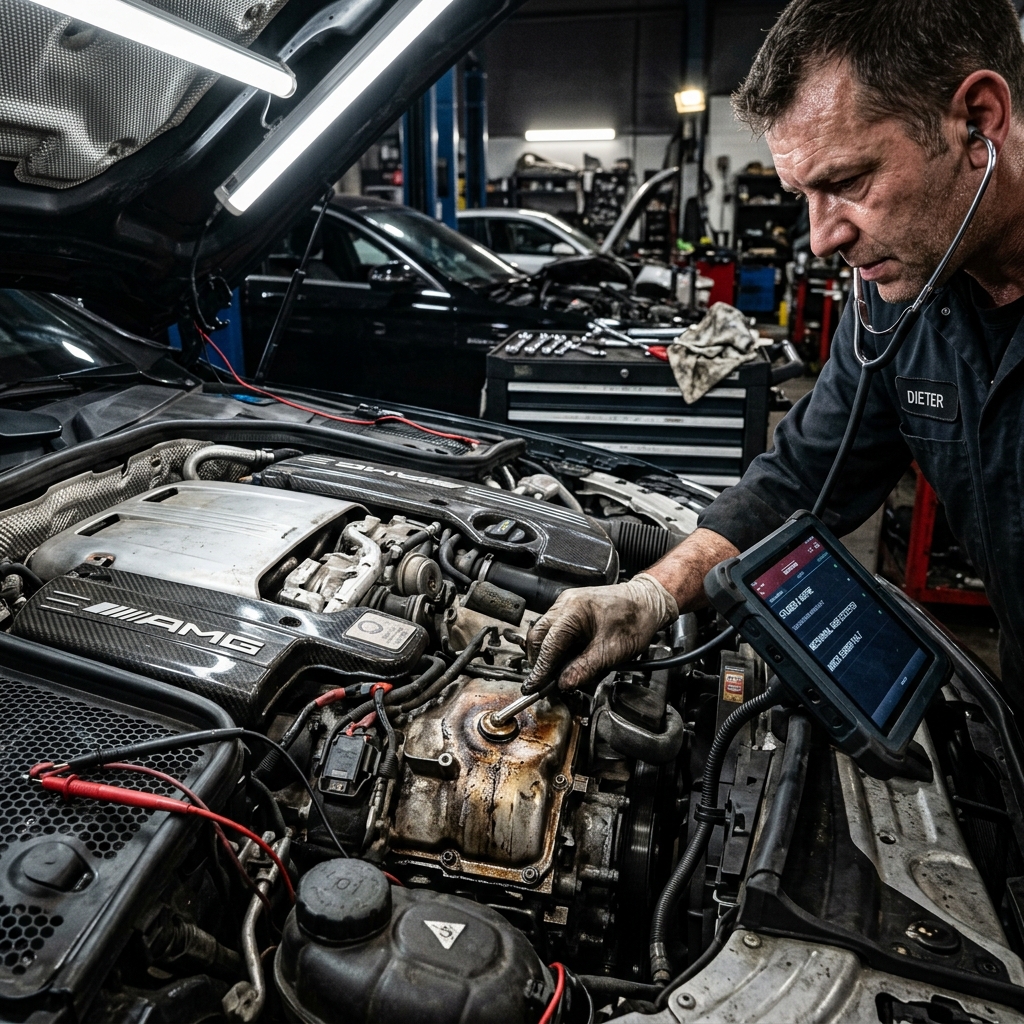
We drain the oil and cut open the oil filter. If we find copper or silver metallic flakes that look like glitter, the bearing material has failed. If the crank is scored, the entire block is usually compromised.
Cost Transparency: Parts + Labor Breakdown
| Repair Job | Est. Parts | Est. Labor | Total Worst-Case |
|---|---|---|---|
| Preventative Rod Bearing Replacement | $800 | $1,500 | $2,300 |
| Engine Rebuild (Minor Damage) | $4,500 | $6,000 | $10,500 |
| Complete Engine Replacement (Dealer) | $22,000+ | $4,500 | $26,500+ |
Lower-Risk Alternatives
- Lexus GS F / RC F (2UR-GSE V8) Bulletproof naturally aspirated V8 with zero documented rod bearing flaws.
- Audi RS5 B9 (EA839 2.9T) Modern V6 design with highly solid lower-end architecture compared to older V8s.