Turbo Whistle Sound Explained: Normal vs Warning Sounds in Performance Cars
"The turbo on your BMW or Porsche makes a high-pitched whistle under acceleration. Is it the compressor surge you're hearing, or shaft play? A stethoscope and this guide will tell you."
Engine
4/10
Gearbox
4/10
Electric
3/10
Total Risk
7/10
Quick Verdict
AvoidExtremely high risk of catastrophic failure. Requires massive emergency budget.
Reliability Verdict
If the turbo sounds like a dentist drill or a police siren that pitches up and down with RPM, the compressor wheel bearings are destroyed. Continued driving will send metal shrapnel directly into your engine block.
Executive Intelligence Summary
Why does your twin-turbo luxury engine sound like a police siren? Learn the difference between a normal spooling sound and a $10,000 catastrophic turbo failure.
In This Guide
Twin-turbo V8s define the modern era of luxury performance. From the Mercedes-AMG M177 to the BMW S63, these engines produce massive torque by forcing air into the cylinders. But when that forced induction system starts sounding like a dental drill, your wallet is in serious danger.
Turbochargers in modern luxury cars spin at upwards of 150,000 RPM. They live in an incredibly hostile environment, often nestled right inside the “V” of the engine block (the Hot-V configuration), subjecting them to extreme heat.
The Three Sounds of a Turbocharger
When diagnosing an odd noise coming from a turbocharged engine, you need to identify exactly what type of sound it is.
1. The Normal “Whoosh” or Spool
A faint, rushing air sound as the RPMs climb is completely normal. This is simply the sound of the compressor wheel drawing in ambient air and compressing it. If you have aftermarket “open” intakes, this sound will be much louder.
- Verdict: Normal. No action required.
2. The Boost Leak (Loud Hissing)
If your car suddenly feels sluggish, you get a “Drivetrain Malfunction” or “Underboost” code (P0299), and you hear a very loud hissing sound under heavy acceleration, you likely have a boost leak.
- The Cause: A plastic charge pipe has cracked, or an intercooler hose has popped off under pressure.
- Verdict: Cheap and easy fix. Commonly seen on the BMW N63 Reliability - he $10,000 Hot Reliability: Common Problems & Repair Cost Guide ($5,000 - $25,000+).
3. The “Police Siren” or “Dental Drill” Whine
If you hear a distinct, mechanical, high-pitched whining noise that goes up and down with the engine RPM. Then when you aren’t perfectly in boost - u have a severe mechanical problem. It sounds remarkably like a police siren half a block away.
- The Cause: The fluid bearings inside the center cartridge of the turbocharger have failed. The compressor wheel is now wobbling and physically grinding against the metal turbo housing.
- Verdict: Catastrophic failure. The turbo must be replaced immediately before it sends metal shards into the engine block.
The Worst Offender: Audi 4.0T (C7 S6, S7, RS7)
The most infamous case of turbo whistle in the luxury segment belongs to the Audi 4.0L Twin-Turbo V8 (EA824), used in the C7/C7.5 generation S6, S7, RS7, and A8.
Audi engineers placed a tiny, incredibly fine mesh oil strainer screen deep inside the valley of the engine block to filter oil going to the turbos. Over time, this screen clogs with carbon deposits and sludge. Once the screen clogs, oil flow to the turbos drops to zero.
- Spinning at 100,000+ RPM with no oil, the turbocharger bearings instantly overheat and seize.
- The shaft snaps, the impeller wheel grinds into the housing (creating the siren sound), and the car loses all power.
- The Fix: A $10,000+ replacement of both turbochargers, requiring the engine to be significantly torn down or removed. Audi later issued a recall to remove the screen entirely, but many used cars missed the campaign.
BMW S63 & Mercedes M177 Heat Soak
While Audi struggled with oil starvation, both the BMW S63 (F90 M5, X5M) and Mercedes-AMG M177 (W205 C63, E63) struggle with pure thermal overload.
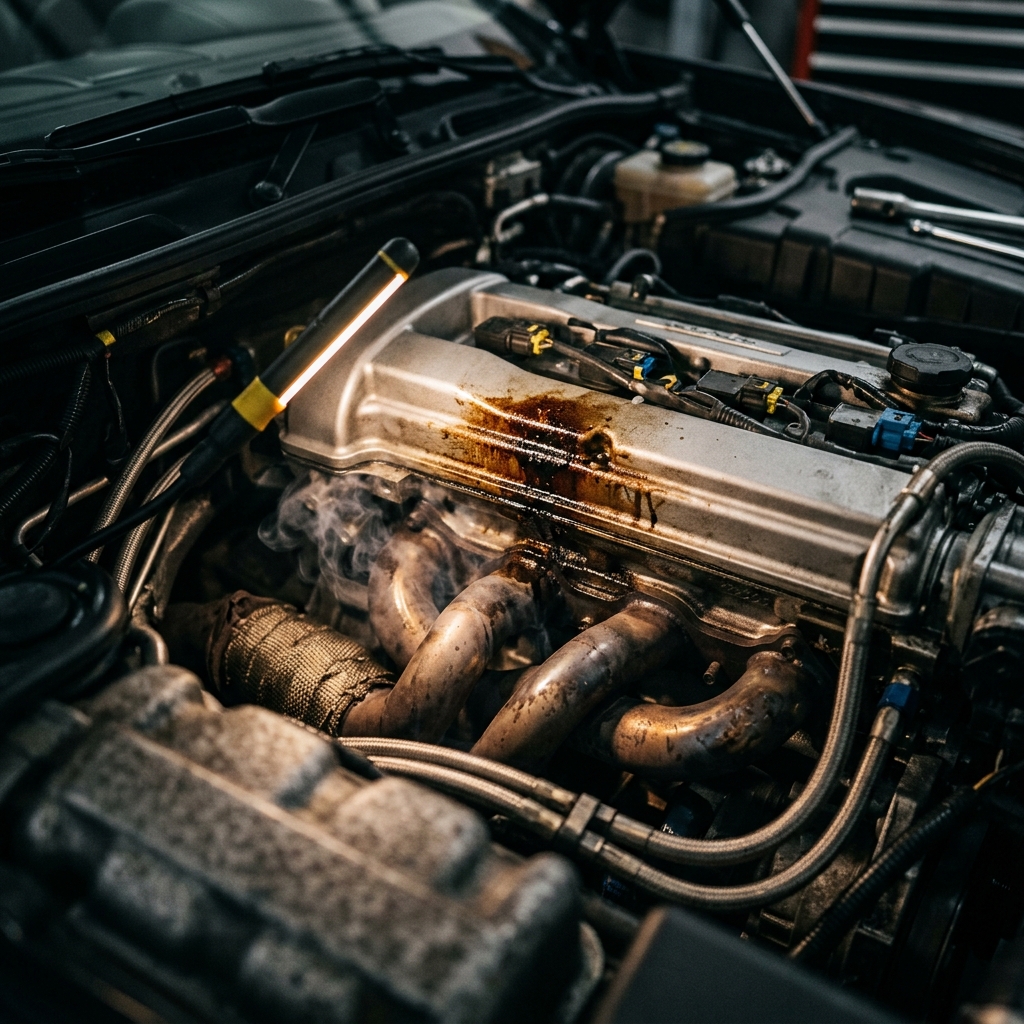
Because the turbos sit inside the valley of the engine (Hot-V), they bake in their own heat after the car is turned off. Over 60,000 miles, this heat bakes the plastic and rubber coolant lines that feed the turbos, causing them to crack and leak. If the turbos lose coolant flow, the bearings will warp, resulting in the dreaded siren whine.
- Read the Deep-Dive: Mercedes M177 Reliability
- Read the Deep-Dive: BMW S63 Reliability
Real Owner Symptoms
"Owners notice a distinct, high-pitched whining or 'police siren' wail that gets louder as the car comes into boost (2,000 - 4,000 RPM). It is often accompanied by a sudden loss of power or a 'Drivetrain Malfunction' warning on the dash."
Mechanic's Diagnosis Notes
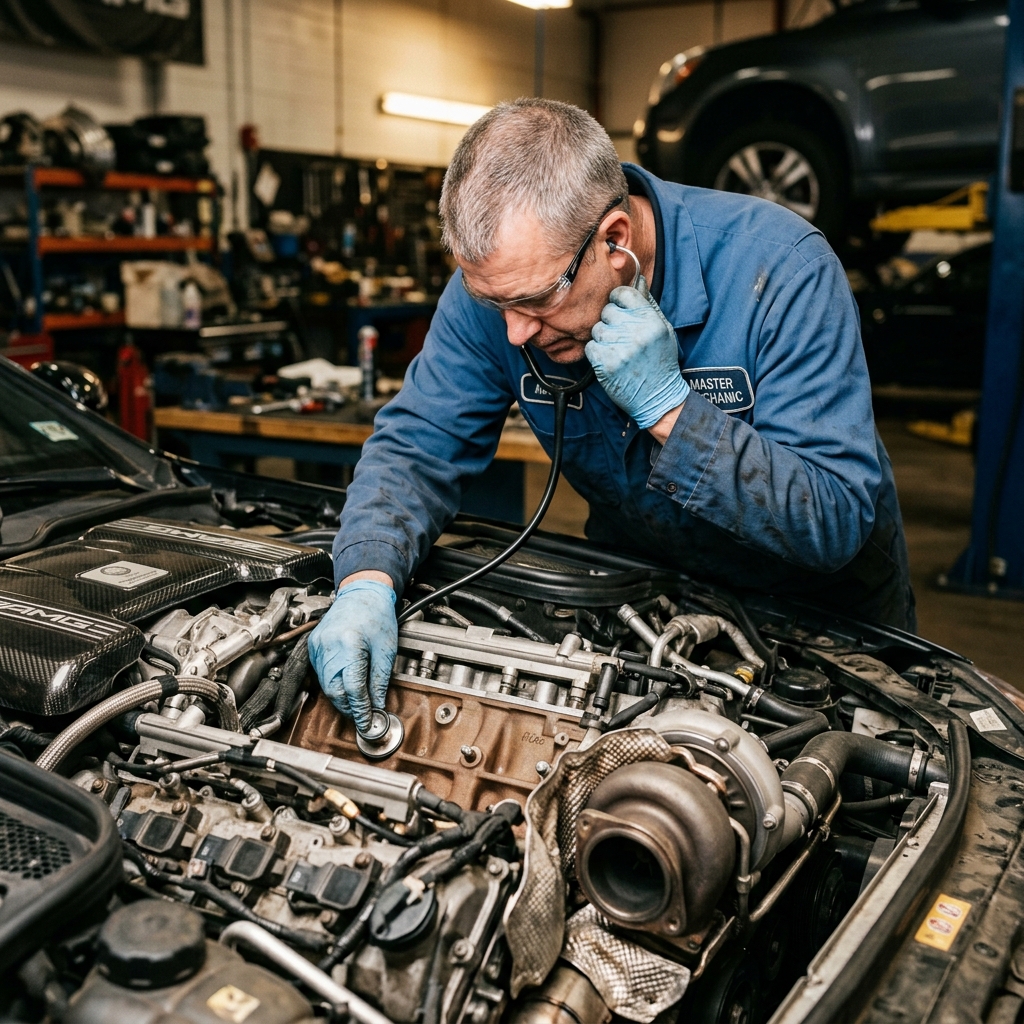
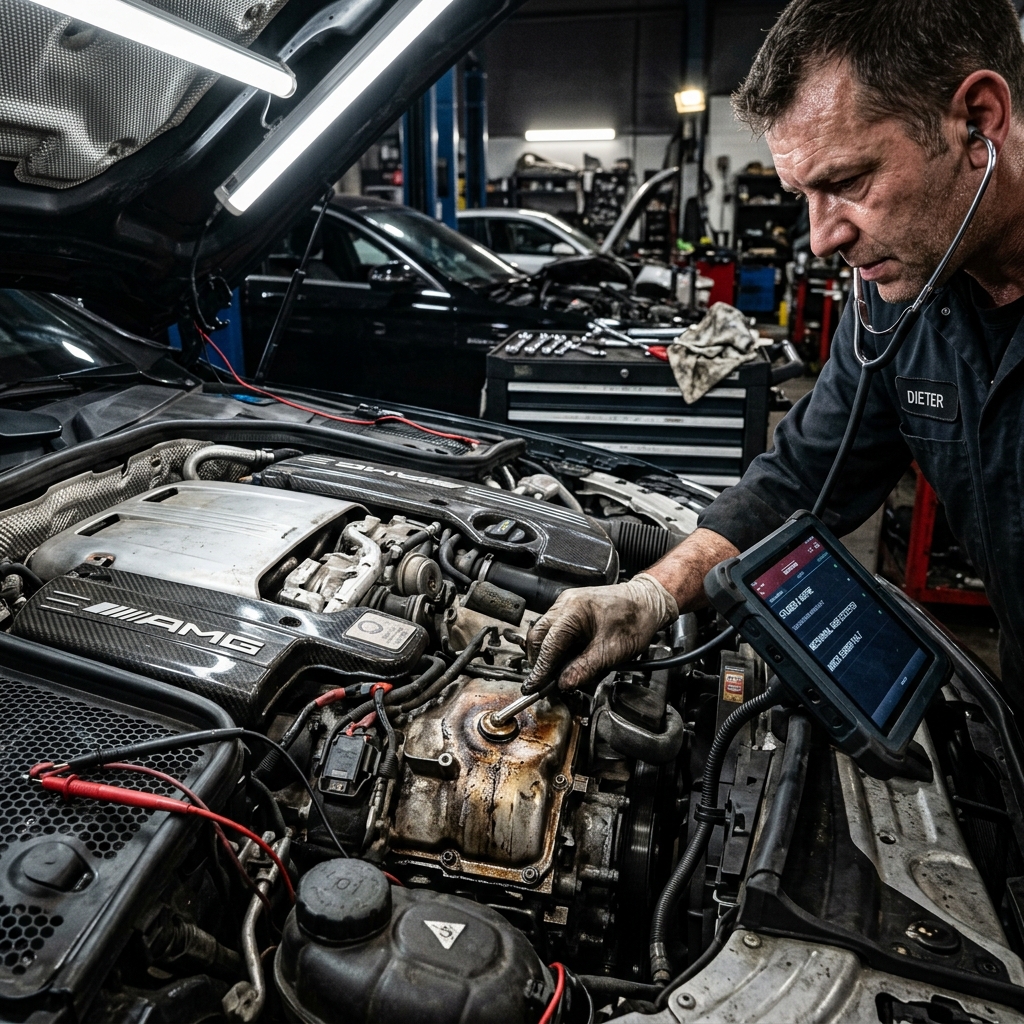
The first thing we do is pull the intake piping off the front of the turbos. If we can reach in and wiggle the compressor wheel up and down, the bearing cartridge is completely shot. If the wheel has struck the housing, the entire turbo is garbage.
Cost Transparency: Parts + Labor Breakdown
| Repair Job | Est. Parts | Est. Labor | Total Worst-Case |
|---|---|---|---|
| Boost Leak (Pipe/O-Ring) | $150 | $300 | $450 |
| Single Turbo Replacement (Independent) | $2,800 | $1,800 | $4,600 |
| Twin Turbo Replacement (Dealer / Engine-Out) | $6,500 | $5,500 | $12,000+ |
Lower-Risk Alternatives
- Porsche Panamera GTS (4.0 V8) Porsche's twin-turbo V8 design suffers far fewer heat-related turbo bearing failures than BMW or Audi.