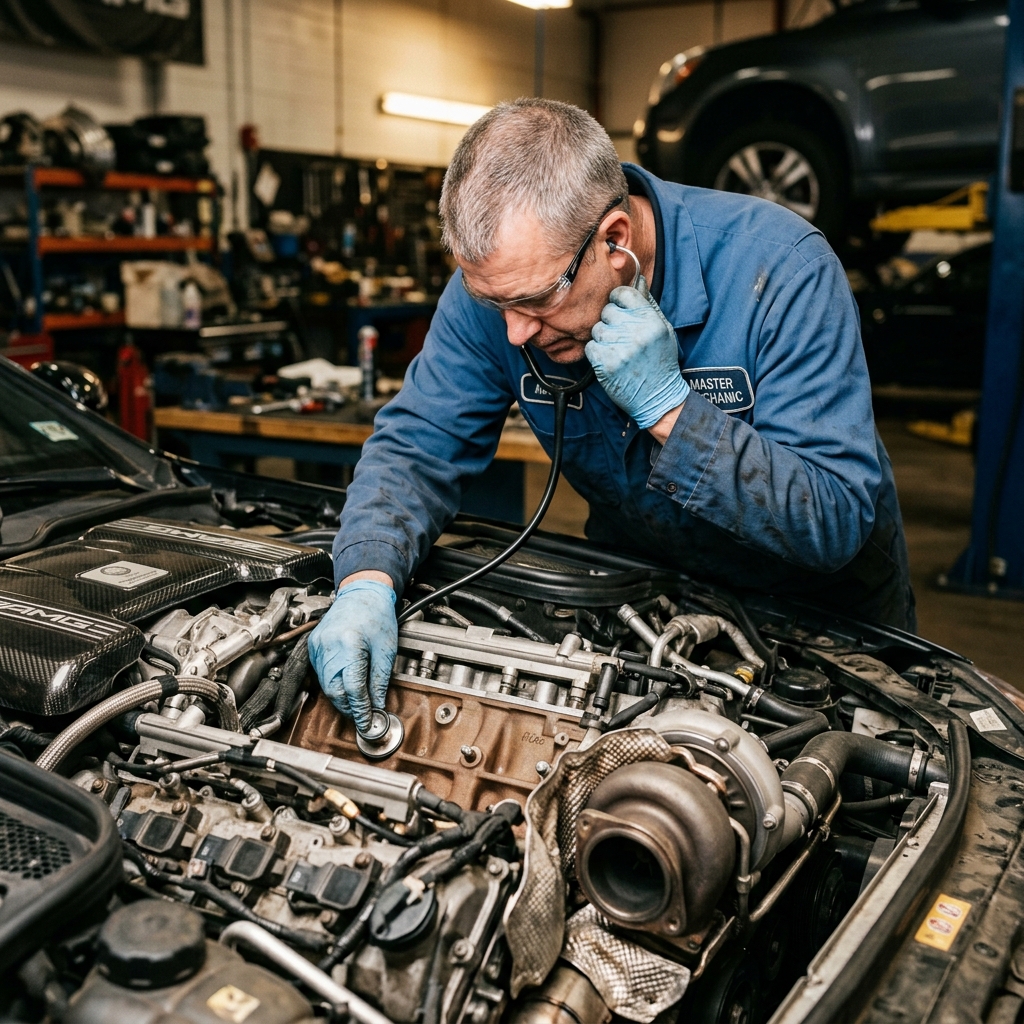
Rough Idle in Luxury Cars: Diagnosis, Common Causes & Repair Guide
"Your luxury car shakes at red lights. The tachometer dips and recovers. It could be a vacuum leak or a ,000 injector failure. Start with these diagnostic steps."
Engine
6/10
Gearbox
6/10
Electric
5/10
Total Risk
5/10
Quick Verdict
Buy with CautionExpect significant running costs. Manageable if preventative maintenance is done.
Reliability Verdict
If the steering wheel vibrates violently at idle but smooths out when driving, your fluid-filled engine mounts have collapsed. If the engine stumbles, shakes randomly, and flashes a check engine light, you have a misfire.
Executive Intelligence Summary
A rough idle on a modern luxury car is never just 'bad gas.' Learn the difference between failing engine mounts, misfires, and catastrophic vacuum leaks on A...
In This Guide
One of the defining characteristics of a high-end luxury car is total isolation from the engine compartment. Whether you are driving an S-Class or an M5, the idle should be perfectly smooth. If your steering wheel is vibrating or your engine is stumbling at a red light, the car has a mechanical fault.
“Bad gas” is a common excuse used by used car dealers, but modern direct-injected, turbocharged V8s almost never experience a rough idle simply due to fuel quality. The true culprits belong in two categories: Physical Isolation or Combustion Issues.
Culprit 1: Collapsed Active Engine Mounts
If your car vibrates rhythmically at idle (especially when in ‘Drive’ with your foot on the brake), but the vibration completely disappears once you accelerate past 1,500 RPM, you have collapsed engine mounts.
- How They Work: Modern luxury cars like the Mercedes S-Class and Porsche Panamera do not use solid rubber blocks to bolt the engine to the chassis. They use highly complex, active, fluid-filled mounts that stiffen during aggressive driving and soften to absorb vibrations at idle.
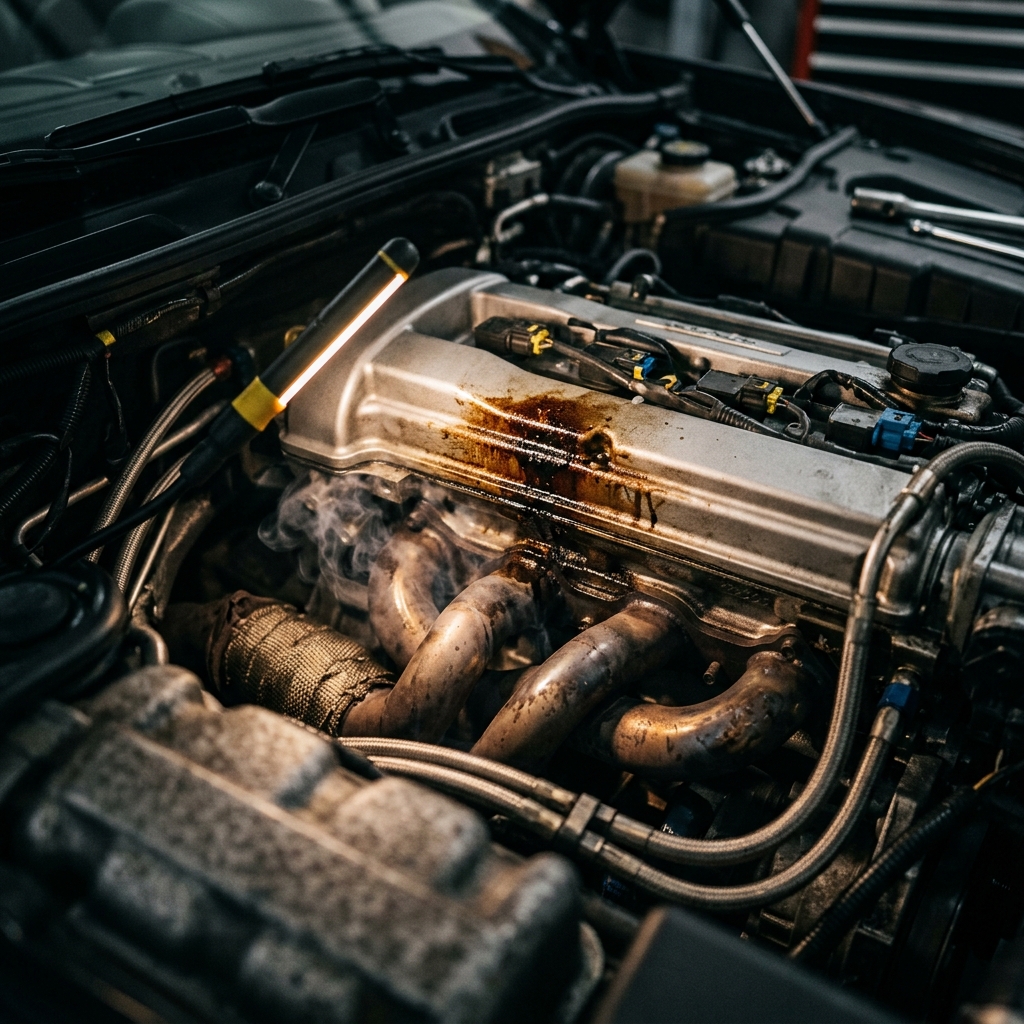
- The Failure: The immense torque and heat of a twin-turbo V8 eventually crack the rubber casing of the mount. Once the hydraulic fluid (often a dense brown liquid) leaks out, the massive engine rests directly on the metal subframe, transferring every vibration directly into the cabin.
- The Cost: Because these mounts often require dropping the subframe or partial engine lifting, replacing a pair typically costs $1,500 to $3,500.
Culprit 2: The Stumbling Misfire
If the vibration is erratic - aning the engine feels like it is “stumbling” or “hiccuping,” and the RPM needle on the dashboard is bouncing up and down - u have a combustion problem.
- Ignition Coils & Plugs: High-performance turbocharged engines consume spark plugs at an incredible rate. A Used BMW M3 F80 Buying Guide Reliability & Real Costs or an AMG requires new plugs every 30,000 to 40,000 miles. When a coil or plug fails, the cylinder stops firing, throwing off the perfect balance of the engine. A severe misfire will trigger a flashing Check Engine Light.
- The PCV Valve / Vacuum Leak: The PCV (Positive Crankcase Ventilation) valve regulates air pressure inside the engine block. When the internal diaphragm rips (a notorious issue on the Audi 4.0T and BMW N63), the engine pulls in “unmetered air.” The oxygen sensors detect too much air, the engine leans out, and it struggles to maintain an idle.
- The Fix: A smoke test on the intake system will immediately reveal cracked plastic hoses or a ripped PCV diaphragm.
Culprit 3: Carbon Buildup (Direct Injection)
All modern luxury engines use Direct Injection (DI), meaning fuel is sprayed directly into the combustion chamber rather than flowing over the intake valves.
- Since no fuel washes the back of the intake valves, oil vapor from the PCV system bakes onto the hot valves, forming thick, hard, carbon stalactites.
- The Symptom: When you start the car completely cold (like on a winter morning), the engine will misfire, shake, and stumble for the first 30-60 seconds, then smooth out entirely as it warms up.
- The Fix: The intake manifold must be removed, and the valves must be “walnut blasted” (physically scrubbed clean using crushed walnut shells and a high-powered vacuum). Expect this service every 60,000 to 80,000 miles on almost all German V8s.
Real Owner Symptoms
"Owners report that the car feels perfectly smooth on the highway, but when stopped in gear at a red light, the steering wheel, seat, and dashboard vibrate noticeably. In worse cases, the idle RPM bounces up and down erratically."
Mechanic's Diagnosis Notes
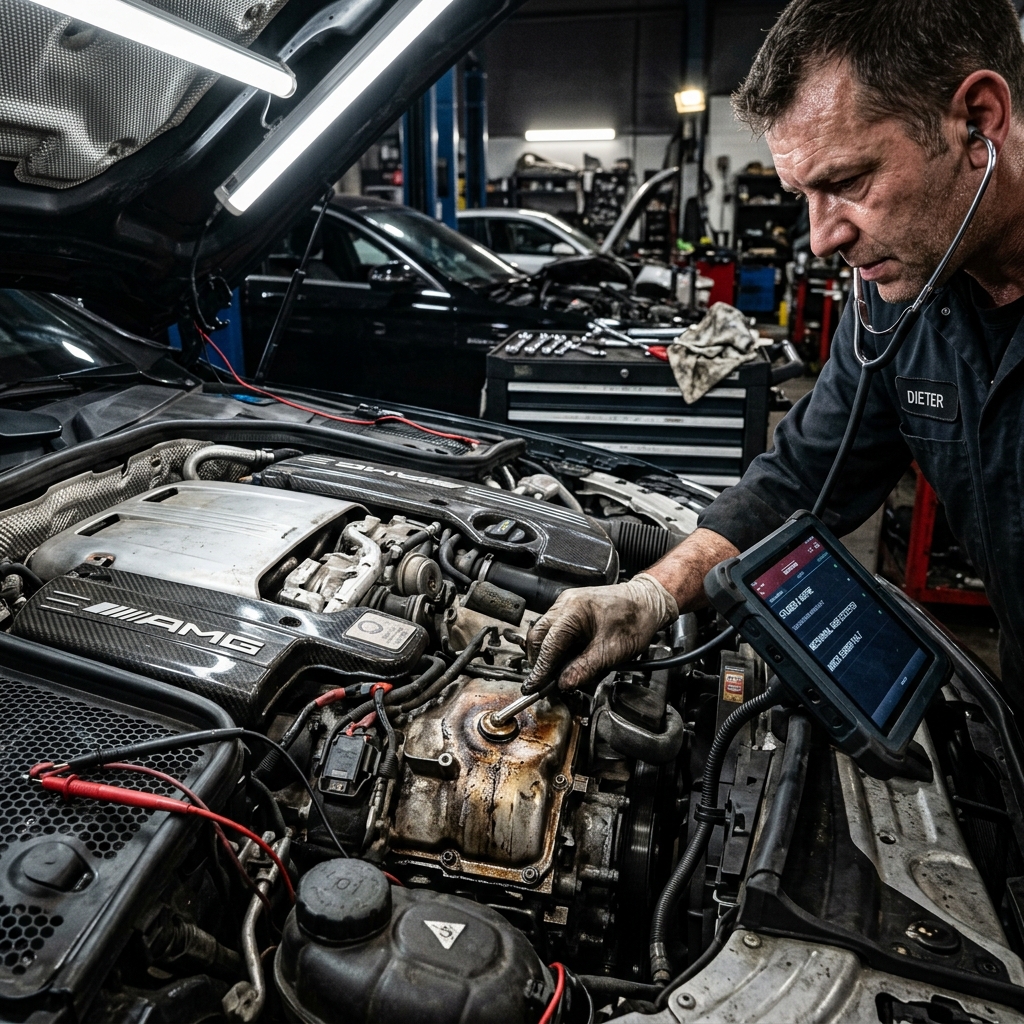
The first check is always scanning the OBD2. If there are no misfire codes (P0300-P0308), we physically inspect the engine mounts. Luxury car mounts are active, fluid-filled, and electronically controlled. When the rubber cracks, they leak brown hydraulic fluid and collapse.
Cost Transparency: Parts + Labor Breakdown
| Repair Job | Est. Parts | Est. Labor | Total Worst-Case |
|---|---|---|---|
| Spark Plugs & Ignition Coils (V8) | $450 | $300 - $600 | $750 - $1,050 |
| Active Engine Mounts (Pair) | $600 | $800 - $1,500 | $1,400 - $2,100 |
| Vacuum Leak / PCV Valve | $150 | $500 - $1,200 | $650 - $1,350 |
Lower-Risk Alternatives
- Lexus LS500 / LC500 Lexus engine mounts traditionally outlast German active mounts by a factor of 2:1.